DOM-IDEN-001: Canonical Identity Model
| Reference Number | Version | Effective Date | Supersedes | Authority Level |
|---|---|---|---|---|
| DOM-IDEN-001 | 2.3 | 2026-09-15 | 2.2 | Constitutional |
I. Purpose
This document defines the constitutional identities that are valid within the Classroom Token Hub space. Any other identity construction or entity SHALL be considered as invalid and prohibited.
Important
This document defines how Classroom Token Hub constructs canonical identities after the required identity information has been ingested. It governs the construction, binding, lifecycle, and deletion of canonical identity objects.
This document SHALL NOT prescribe how identity information is obtained. Authentication providers, roster sources, district information systems, SSO providers, and other provisioning mechanisms are implementation concerns. Regardless of origin, all identity inputs SHALL be transformed into the canonical identity model defined by this document before participating in the Classroom Token Hub runtime.
II. Scope
This domain governs:
- Human identity (
users) - Classroom universes (
classes) - Classroom participation (
seats) - Human-facing identity (
identity_profiles)
This domain does not govern:
- Teacher onboarding
- Student roster provisioning
- Student claim
- Account recovery
- Class binding
- Identity lifecycle
- Identity deletion
- Runtime request context
- Financial truth (Ledger)
- Attendance facts
- Store ownership
- Obligations
- Class policy
III. Authority Level
Tier 1 — Constitutional. This document defines structural enforcement mechanisms and domain-specific constraints that operationalize Foundational invariants. It is subordinate to INV-CORE-000, INV-CORE-001, and INV-ARC-008.
IV. Dependencies
INV-CORE-000_CORE_INVARIANTS.mdINV-CORE-001_CAPABILITY_BASED_ARCHITECTURE_AND_AUTHORITY_MODEL.mdINV-ARC-008_IDENTITY_RESOLUTION_AND_SEAT_SCOPE.mdDOM-CORE-000_DOMAIN_FOUNDATION.mdINV-ARC-019_IDENTITY_AND_OWNERSHIP_MODEL.md
V. Core Identity and Tenancy
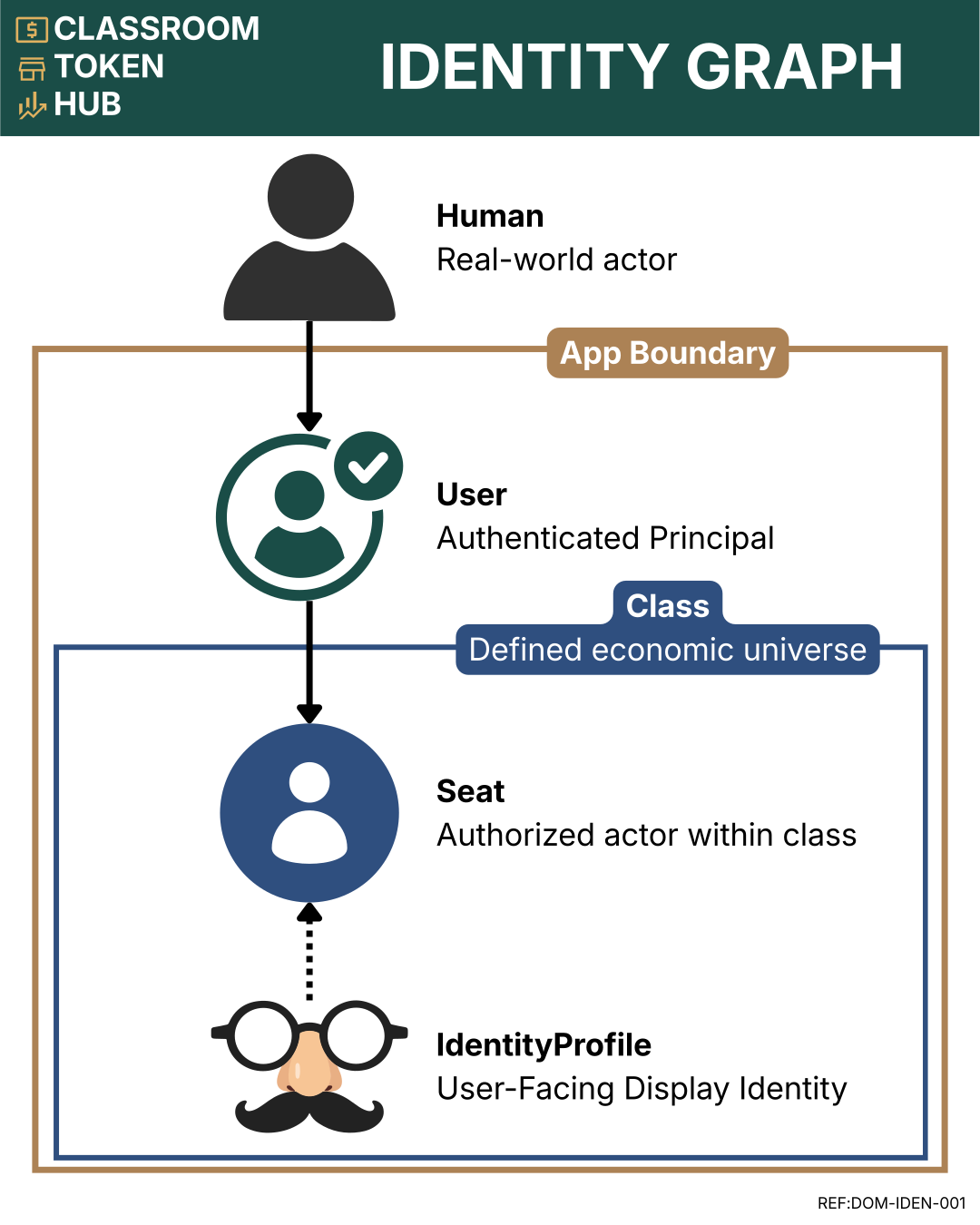
To preserve isolated classroom economies and prevent cross-context authority leaks, Classroom Token Hub separates canonical identity into four distinct architectural responsibilities. Each responsibility owns exactly one concern and SHALL NOT assume responsibilities owned by another identity object.
User
A User is the authenticated principal that owns authentication credentials, account lifecycle, recovery, and global authentication state.
Class
A Class defines an isolated classroom universe. Every runtime actor, policy, obligation, ledger event, attendance event, and store interaction SHALL occur within exactly one Class.
Seat
A Seat is the canonical runtime actor within a defined Class. It represents the entity that can engage in the classroom economy within the Class. A Seat represents a single member within the Class that is bound to exactly one authenticated User.
IdentityProfile
An IdentityProfile represents the human-facing display data associated with a Seat within a Class. Its primary function is ease of use and user experience. IdentityProfile SHALL NOT participate in authentication, authorization, ownership determination, canonical context construction, or business logic. External hall-pass verification uses the display names to check for a same-day entry within a capability-authorized class scope. This does not resolve an economic actor or establish authority (INV-ARC-019 §X).
Collectively, these four objects constitute the canonical identity model of Classroom Token Hub. No other object, legacy table, or compatibility bridge may originate identity or classroom participation.
VI. Participation Model
Participation is represented exclusively through Seats. Users authenticate the human entity while Seats act within the defined economy of Classes.
Classesdefine the universe in whichSeatsact.- A
Usermay participate in multipleClassesthrough multipleSeats. - A
Usermay own at most oneSeatperClass. - A
Seatbelongs to exactly oneClass.
Participation Existence Law
- A
UserSHALL exist only while participating in at least oneClass. - Participation is established by binding a
Userto aSeat. - If a
Userno longer owns anySeats, the correspondingusersrow SHALL be removed. - This rule applies equally to teachers and students.
Identity Graph
The following illustration shows how each identity function operates within Classroom Token Hub:
VII. Invariants
- Identity is owned by
Users. - Participation is owned by
Seats. Classesdefine participation boundaries.- One
Usermay own manySeats. - One
Usermay own at most oneSeatwithin aClass. - One
Seatbelongs to exactly oneClass. IdentityProfilesnever own authentication.UsersSHALL NOT exist without classroom participation.
VIII. Amendments
Revisions to this document shall:
- Increment the version.
- Update the effective date.
- Maintain consistency with INV-CORE-000, INV-ARC-004, and INV-ARC-013
Last updated: 2026-09-15